
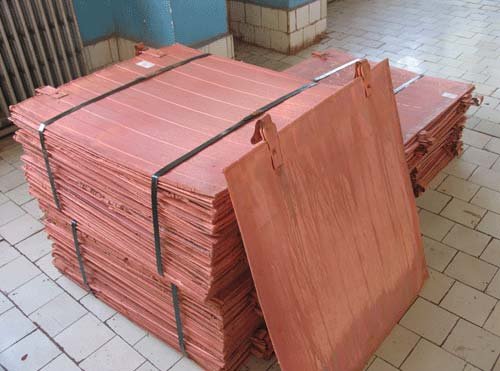


Copper cathodes are supplied for refining and industrial use.
A
copper cathode is the primary raw material used to produce high-purity copper and copper-alloy products. It is typically a rectangular plate of pure copper metal, often reaching a purity level of 99.99%.
Key Specifications & Standards
Purity: Most industrial-grade cathodes are at least 99.97% to 99.99% pure.
Dimensions: Typically in surface area and 3 to 20 mm thick. Common commercial sizes are approximately 914mm x 914mm.
Weight: Individual sheets usually weigh between 100 kg and 150 kg.
Standards: High-quality cathodes are often certified to LME Grade A (London Metal Exchange) or ASTM B115 standards.
Production Process
Copper cathodes are produced through two main industrial pathways:
Electrolytic Refining (Pyrometallurgy): Copper ore is smelted into 99% pure “blister” copper anodes, which are then placed in an acid bath. An electric current causes pure copper ions to migrate from the anode to a starter sheet (the cathode), leaving impurities behind.
Electrowinning (SX/EW – Hydrometallurgy): Used for oxide ores, this involves leaching the ore with acid to create a copper sulfate solution. This solution undergoes solvent extraction, and then electrolysis deposits pure copper directly from the liquid onto cathodes.
Industrial Applications
As a semi-finished product, copper cathodes are melted and cast into other forms:
Wire Rods: The most common use, processed into electrical wiring for homes, electronics, and power grids.
Billets & Cakes: Used to manufacture copper tubes, pipes, sheets, and bars for construction and plumbing.
Alloys: Integrated into over 450 alloys, including brass and bronze.
Renewable Energy: Essential for electric vehicle (EV) motors, charging infrastructure, and wind/solar components.