
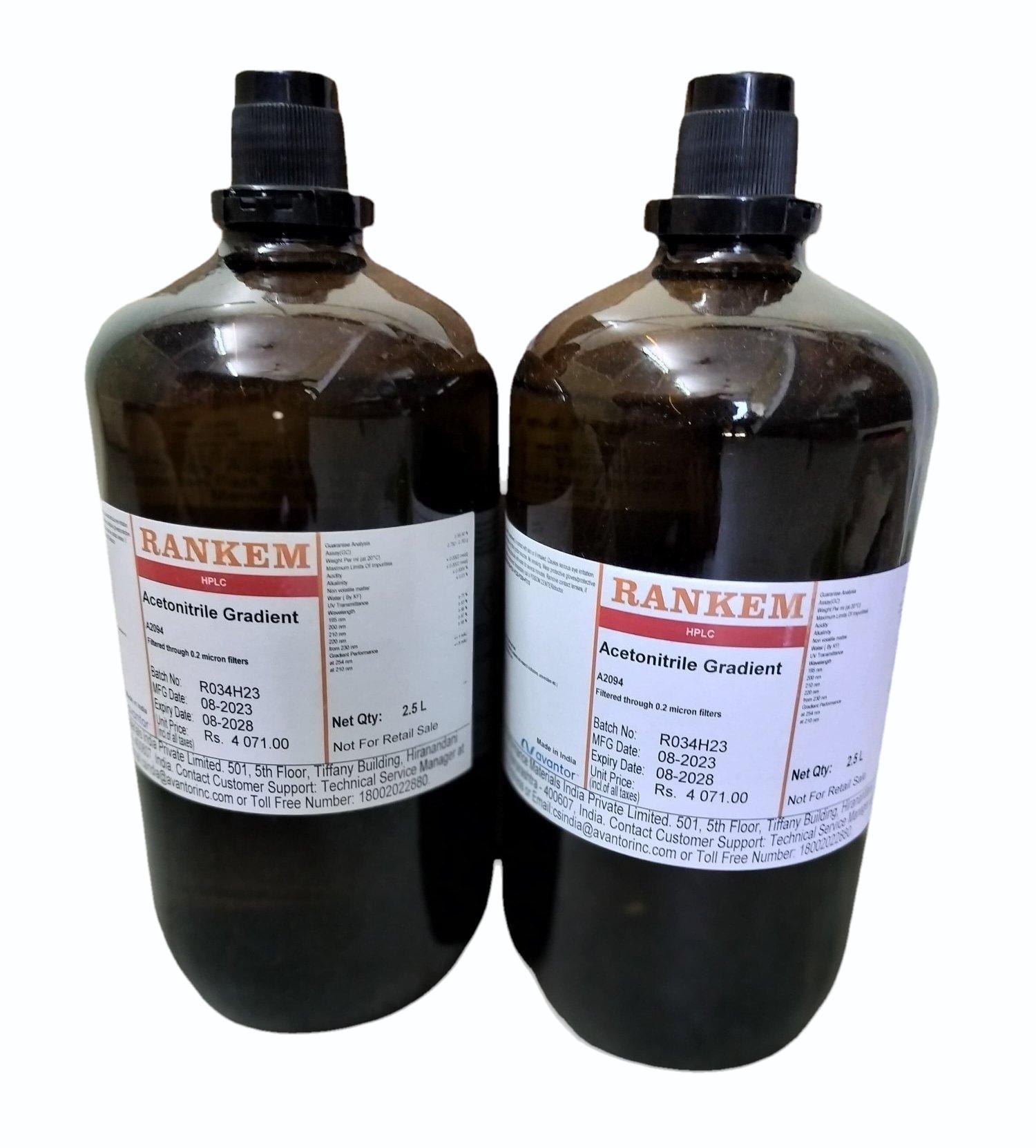
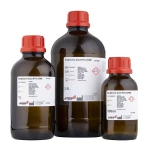
Acetonitrile HPLC Gradient

Acetonitrile HPLC grade is used in chromatographic analysis pharmaceutical testing and laboratory separations.
Acetonitrile is a preferred high-purity, low-viscosity, and UV-transparent (down to 190 nm) solvent for HPLC gradient analysis, offering lower backpressure and stronger elution strength than methanol. It is essential for reverse-phase chromatography (RPLC) to achieve precise, low-drift baselines, particularly at wavelengths as low as 210 nm or 254 nm.
Key Characteristics & Recommendations:
Grade: HPLC Gradient Grade (filtered to 0.2
Properties: Boiling point 81-82°C, density 0.786 g/mL, and low viscosity.
Suitability: Ideal for LC-MS and high-sensitivity analysis.
Storage: Generally stored at room temperature.
Usage in Gradient Systems:
Acetonitrile is used as the organic solvent (Mobile Phase B) in conjunction with an aqueous phase (Mobile Phase A) to elute components based on increasing organic concentration.
Column Equilibration: Ensure proper flushing, typically 10 column volumes or until the baseline stabilizes.
Gradient Optimization: The high elution strength of acetonitrile allows for efficient separation of non-polar compounds.