
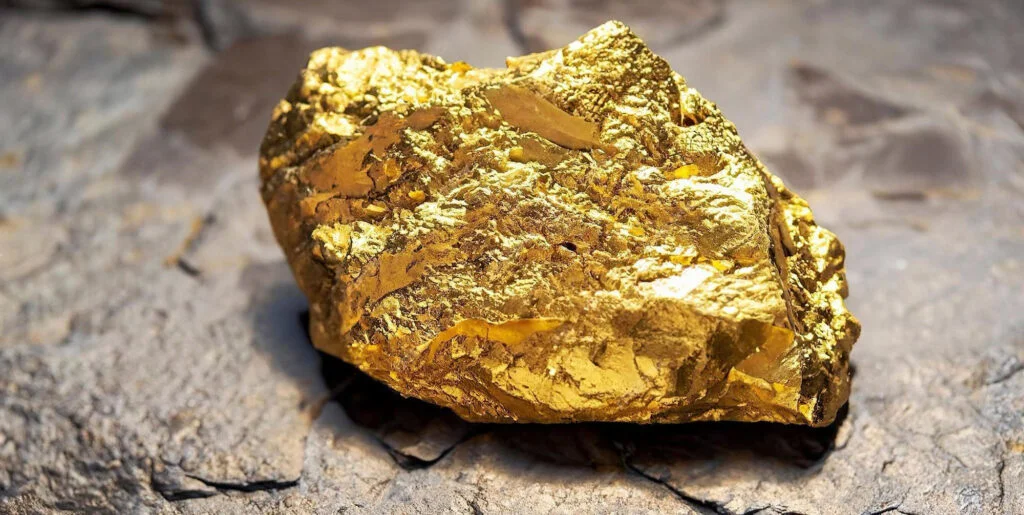


Gold ore is supplied for mineral processing metallurgical research and industrial applications.
Gold ore is a naturally occurring rock or mineral aggregate that contains gold in concentrations high enough to be economically viable for mining and extraction. The gold within the ore can be visible to the naked eye (native gold) or microscopic and embedded within other minerals, such as sulfides or tellurides.
Characteristics and Identification
Gold ore characteristics vary widely based on the deposit type and associated minerals, but some general physical and chemical properties can aid in identification.
Color and Luster: Real gold has a soft, bright metallic yellow luster that “glows” rather than sparkles harshly like pyrite (“fool’s gold”).
Density: Gold is extremely dense, with a specific gravity of around 19.3 g/cm³, much heavier than most other minerals (lead is 11.34 g/cm³). A gold-bearing rock will feel unusually heavy for its size.
Malleability: Unlike brittle look-alikes which break or shatter, native gold is soft and malleable; it will flatten or dent when struck with a hammer or scratched with a knife.
Chemical Inertness: Gold does not tarnish, rust, or corrode and is resistant to most acids, with the notable exception of aqua regia (a mixture of nitric and hydrochloric acids) and alkaline cyanide solutions used in processing.
Streak Test: Rubbing gold on an unglazed porcelain plate leaves a yellow streak, whereas pyrite leaves a greenish-black streak.
Associated Minerals: Gold is often found in quartz veins and is frequently associated with iron staining (limonite or hematite, indicating weathered sulfides) and sulfide minerals like pyrite or arsenopyrite.
Types of Gold Ore Deposits
Gold deposits are classified by their geological formation and processing behavior.
Placer Deposits: Formed by the weathering and erosion of primary deposits, gold particles (flakes, granules, or nuggets) are naturally concentrated in riverbeds, streams, or ancient floodplains.
Orogenic/Hydrothermal Veins (Lode Deposits): The most common type of primary deposit where hot, mineral-rich fluids circulate through cracks in the Earth’s crust, precipitating gold and quartz in veins.
Sulfide-Associated Ores (Refractory): Gold is finely disseminated and physically locked within sulfide minerals (e.g., pyrite, arsenopyrite) and is resistant to simple cyanide leaching, requiring pre-treatment to break the sulfide matrix.
Carbonaceous Ores: These ores contain organic carbon that can re-adsorb dissolved gold during the extraction process (known as “preg-robbing”), necessitating special treatment methods.
Telluride Ores: Gold is chemically bonded to tellurium, making it more challenging to extract with standard methods.